
The Prices Keep Going Up. Here's How Australian Small Businesses Can Use AI to Protect Their Margins.
Australian businesses are under a fair bit of pressure right now.
Fuel prices are surging on the back of the Iran conflict, and suppliers are passing every cent of that onto you through delivery charges and fuel levies. From July 1, payday superannuation changes mean you’re fronting super payments in real time rather than quarterly, tightening your cash flow overnight. And from October 1, 2026, the RBA is banning customer surcharges on most credit and debit card payments — meaning businesses will either absorb transaction fees or raise prices to cover them, at a time when customers are already price-sensitive.
The pressure isn’t going away. But neither is your ability to respond to it.
AI is one of the most accessible and underused levers available to Australian small business owners right now.
Most people think AI means ChatGPT. It’s a lot more than that and a lot of it is either free or already embedded in tools you’re paying for.
Here’s where you can start.
1. Look out for supplier fee creep
Supplier invoices are worth a closer look every now and then.
Not because suppliers are doing anything wrong, but because costs shift quietly over time.
What to do:
Export your last three months of supplier invoices as PDFs or CSVs. Open Claude or ChatGPT and upload them with this prompt:
“Compare these invoices month on month. Flag any price increases, new line items, or charges that weren’t present in earlier invoices. Summarise the changes in dollar terms.”
You’ll get a clear breakdown of what’s changed and by how much.
It’s worth doing regularly with your highest-volume suppliers, even just once a quarter, to make sure nothing’s crept in that you haven’t signed off on.
2. Check whether your fuel levies actually stack up
Fuel levies are their own conversation, separate to general invoice auditing and worth looking at specifically right now.
With fuel prices rising on the back of global supply disruptions, freight and delivery surcharges have moved up across the board.
Most of the time these levies are legitimate. But it’s reasonable to ask whether what you’re being charged reflects what fuel actually costs right now.
The Australian Institute of Petroleum (AIP) publishes weekly retail fuel price data.
What to do:
Take the fuel levy line from your most recent freight or delivery invoice and paste it into ChatGPT or Claude with this prompt:
“Based on current AIP weekly terminal gate pricing, is a [X]% fuel levy on a [Sydney to Melbourne] freight run reasonable? What would a fair levy look like at current prices?”
It gives you something factual to reference if you want to have that conversation with your supplier.
For larger operators managing multiple freight relationships, tools like Freightos or CargoWise offer more structured benchmarking across your whole freight spend.
3. Take a closer look at how you’re rostering
Labour is typically the largest controllable cost for hospitality and retail businesses. Some owners roster based on what’s worked before whilst others look for opportunities for savings.
The platforms to look at:
Deputy and Tanda are the two most relevant AI-powered rostering tools for Australian businesses, both built for the local market including Award interpretation and Fair Work compliance.
Both connect to your point-of-sale system and use historical sales data to forecast demand and suggest staffing levels. So instead of defaulting to what you scheduled last week, you’re working from actual patterns in your own data.
Deputy starts from around $4–6 per user per month.
Worth noting for July 1:
With super now due each pay cycle rather than quarterly, having a clearer view of your total weekly employment cost, including super, before you publish the roster is genuinely useful. Both Deputy and Tanda give you that visibility upfront.
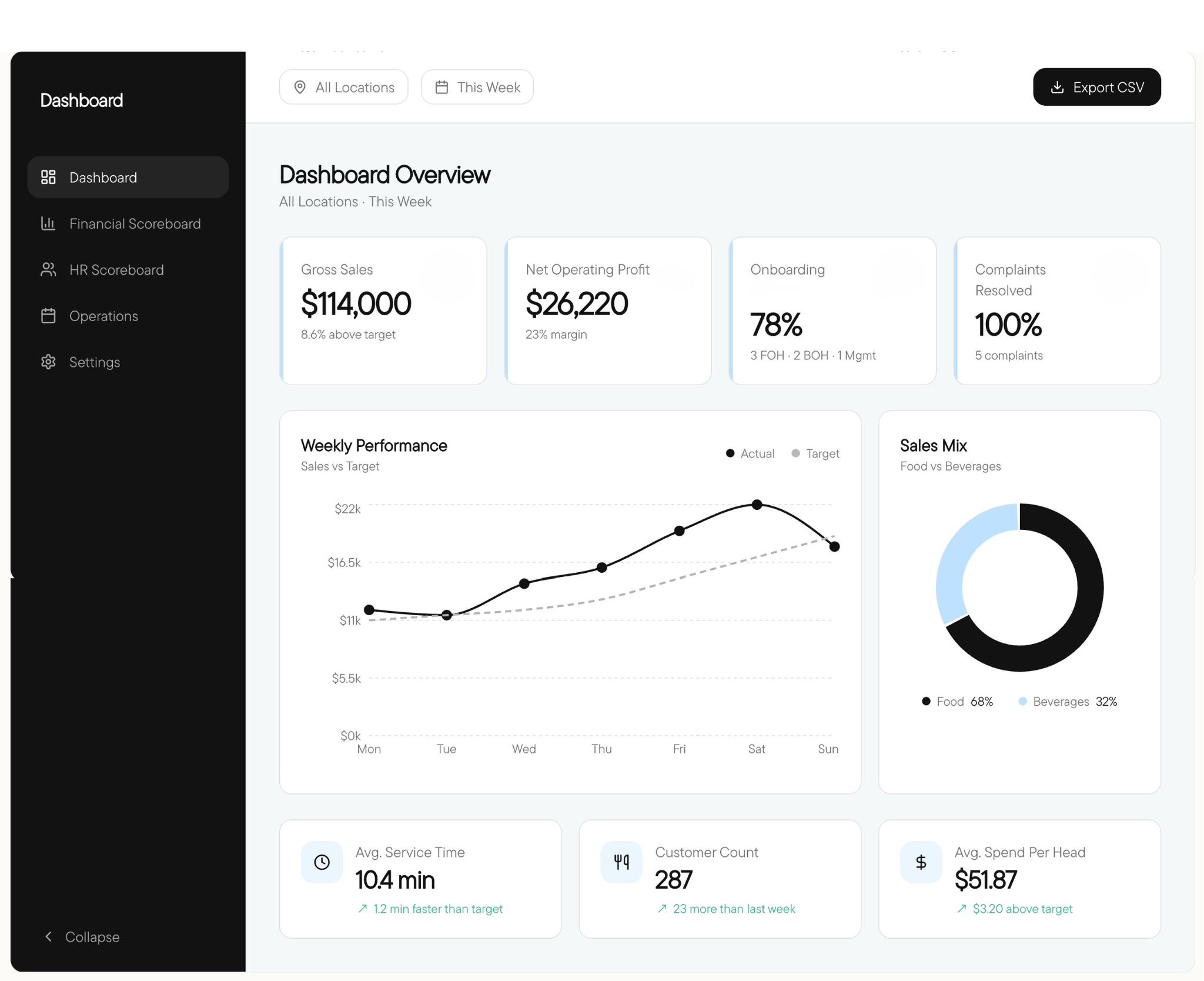
What if you could see all of this data in one place?
We build custom AI-powered dashboards for businesses — connecting your POS, rostering, COGS, and financial tools into a single live view helping you make real-time business decisions.
4. Find the stock that’s sitting still
For retailers and food businesses, slow-moving stock is one of those costs that’s easy to overlook because it doesn’t feel like a cost. But cash tied up in inventory that isn’t moving is cash you can’t use anywhere else.
The platforms to look at:
Cin7 and Unleashed are the two most widely used inventory management platforms for Australian SMEs, and both have AI-assisted demand forecasting built in (for an additional cost).
These tools look at your historical sell-through rates, seasonality, lead times, and supplier minimums to give you a clearer picture of what to order and when. A cafe that’s consistently over-ordering ingredients that expire before they’re used, or a retailer carrying stock that moves once a quarter, gets a straightforward view of where to pull back.
Not ready for a platform yet?
Export your sales data from your POS or inventory system and drop it into Claude with this prompt:
“Based on this sales data, identify the 20% of SKUs with the lowest sell-through rate over the past 90 days. Flag any that haven’t moved in 30 days or more.”
It’s a good starting point to see where your money is sitting before committing to a full platform.
5. Let a voice agent handle the FAQs
Most customer-facing businesses get a steady stream of inbound FAQs. Booking enquiries, location, opening hours, menu items. The calls themselves aren’t complicated, but they interrupt whoever picks up, driving inefficiency.
AI voice agents have come a long way and have moved on from robotic systems similar to ‘press 1 for xyz…” As a business owner, you have the ability to not only choose what your agent sounds like but also how they answer and triage calls.
We’ve seen this work firsthand.
One of our clients automated 89% of their inbound phone calls using an AI voice agent, saving hours each month from staff picking up the phones to answer FAQs. Read the full case study →
6. Take the routine email admin off your team’s plate
Most businesses have a steady flow of emails that need to go out or be responded to. Booking confirmations. Supplier acknowledgements. Customer follow-ups. Order status replies. They’re not complex, but they take time, and in a lot of businesses someone is handling them manually alongside everything else.
What to use:
Gmail with Gemini (if you’re on Google Workspace) can draft replies, suggest responses, and triage inbound emails
Outlook with Copilot does the same for Microsoft 365 users
For more automated workflows, Zapier or Make can connect your inbox to your booking system, CRM, or inventory tool so confirmations go out automatically when an order or booking comes in
The point isn’t to replace anyone. It’s just to stop good people spending chunks of their day on things that could run in the background.
The Bigger Picture
Australian businesses are dealing with major changes all hitting at the same time. Fuel levies, payday super, the surcharge ban, and customers who are watching what they spend. That combination puts real pressure on margins that were already tight.
The businesses that navigate this well probably won’t be the ones that cut the hardest. They’ll be the ones that find a few smarter ways to operate and stack those gains up over time.
-
Not really. The tools mentioned here — ChatGPT, Claude, Deputy, Tanda, Cin7 are all built for everyday use. If you’re comfortable writing an email or using a spreadsheet, you can use these.
-
Quite a range. ChatGPT and Claude both have free tiers and start from under $40 AUD a month. Rostering platforms like Deputy start from around $4–6 per user per month. Inventory platforms like Cin7 and Unleashed vary by business size but are generally in the $100–300/month range.
-
Worth checking the privacy policy of any tool you use. For invoice auditing with ChatGPT or Claude, it’s a good idea to avoid uploading documents with sensitive personal information and use aggregate data where you can.
-
From October 1, 2026, businesses won’t be able to pass credit and debit card surcharges on to customers. You’ll need to either absorb the fees or factor them into your pricing. The average card transaction fee for small businesses sits between 0.5% and 1.5% depending on your merchant agreement.
-
From July 1, 2026, super needs to be paid at the same time as wages rather than quarterly. That means your super liability hits your account every pay cycle rather than in one quarterly lump. Having visibility over your total weekly employment cost ahead of publishing the roster is a practical way to manage it.
